Instructions:
- First, read summary on page 185 from your book "Heat Transfer"
-Create an electronic glossary with the following list. (the vocabulary was taken from the reading).
-Use this platform https://virtualwritingtutor.com/glossary/list for your glossary.
Conduction shape factor
conjunction
That the conduction form factor,
Example: This approach applied to 2-D conduction involving two isothermal surfaces, with all other surfaces being adiabatic. The heat transfer from one surface (at a temperature T1) to the other surface (at T2) can be expressed as: q=Sk(T1-T2) where k is the thermal conductivity of the solid and S is the conduction shape factor.
es: Factor de forma de conducción
Convection resistance
conjunction
Convective Thermal Resistor. Convective Thermal Resistor. where Rconv (SI unit: K/W) is the thermal resistance, which is defined from the surface Area A and the Heat transfer coefficient h as. Model Input. This section has fields and values that are inputs to expressions that define material properties.
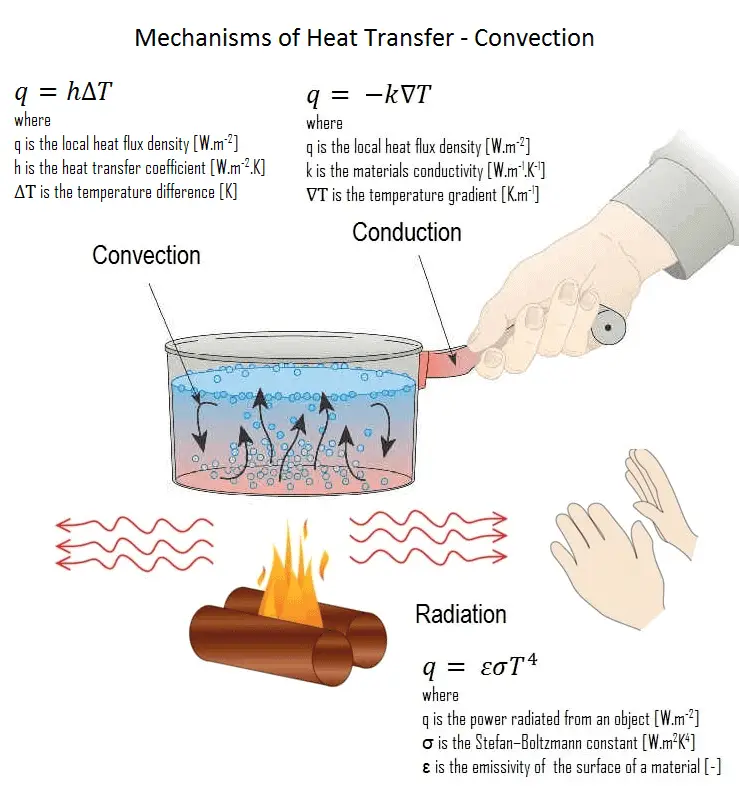
Example: Convection (or convective heat transfer) is the transfer of heat from one place to another due to the movement of fluid. Although often discussed as a distinct method of heat transfer, convective heat transfer involves the combined processes of conduction (heat diffusion) and advection (heat transfer by bulk fluid flow). Convection is usually the dominant form of heat transfer in liquids and gases.
es: Resistencia a la convección
Critical radius of insulation
conjunction
The critical radius of insulation is a counterintuitive concept within the study of heat transfer. The theory states that adding insulation to a cylindrical or spherical object will increase the rate of heat loss rather than decrease it, if the radius (thickness) of the insulation is at its “critical” value.
Example: The Critical Radius of Insulation Senior Project is designed to demonstrate this phenomenon to Heat Transfer students via a portable apparatus.
es: Radio crítico de aislamiento
Cylinder conduction resistance
conjunction
Now consider the one-dimensional steady-state flow of heat through a cylindrical or spherical layer that is exposed to convection on both sides into fluids that are at temperatures T∞1 and T∞2, with heat transfer coefficients h1 and h2, respectively. In this case, the network of thermal resistances consists of a resistance to conduction and two to convection, in series, precisely like that for the flat wall and the rate of heat transfer under stationary conditions
Example: The network of thermal resistances consists of a resistance to conduction and two to convection, in series, precisely like that for the flat wall and the rate of heat transfer in stationary conditions.
es: Resistencia de conducción del cilindro
Efficiency
noun
The performance or efficiency of a heat engine is the relationship between the energy we want to obtain from said machine (work done) and the energy consumed in its operation (energy supplied).
Example: In automobiles, the efficiency ranges from 20-25% of the energy supplied. In other words, 75% of the energy supplied is released into the atmosphere in the form of heat.
es: Eficiencia
Fin effectiveness
conjunction
The extended surfaces have fins attached to the primary surface on one side of a two-fluid or multi-fluid heat exchanger. The fins can be of a variety of geometry (smooth, wavy or interrupted) and can be attached to the inside, outside or both sides of circular, flat or oval tubes or separator sheets. The pins are used primarily to increase the surface area (when the heat transfer coefficient on that side of the fluid is relatively low) and consequently to increase the overall rate of heat transfer. Furthermore, the improved fin geometries also increase the heat transfer coefficient compared to that of a simple fin.
Example: Fin Efficiency takes into account the reduction in temperature potential between the fin and the ambient fluid due to conduction along the fin and convection to or from the fin surface, depending on the heating or cooling situation of the fin. Fin temperature effectiveness or fin efficiency is defined as the ratio of the actual heat transfer rate through the fin base divided by the maximum possible heat transfer rate through the base of the fin, which can be obtained if the entire fin is at the base temperature (that is, the thermal conductivity of the material is infinite).
Fin efficiency
conjunction
Fin efficiency is defined as the ratio of actual fin heat flux to that which would be obtained with a fin of constant temperature uniformly equal to the base surface temperature, that is, one with infinite thermal conductivity.
Example: Fin efficiency is the ratio of the heat transferred by a fin to the heat that would have been transferred if the total surface of the fin were at the base (or wall) temperature.
es: Eficiencia de las aletas
Interface resistance
conjunction
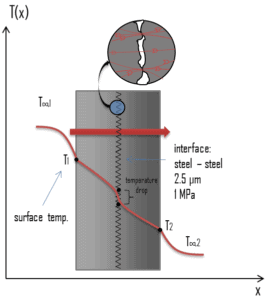
Interfacial thermal resistance, also known as thermal limit resistance or Kapitza resistance, is a measure of the resistance of an interface to heat flow. This thermal resistance differs from contact resistance (not to be confused with electrical contact resistance) because it exists even at atomically perfect interfaces. Due to the differences in the electronic and vibratory properties of different materials, when an energy carrier (phonon or electron, depending on the material) tries to pass through the interface, it will scatter at the interface. The probability of transmission after scattering will depend on the energy states available on side 1 and side 2 of the interface.
Example: Interfacial thermal resistance, also known as thermal limit resistance or Kapitza resistance, is a measure of the resistance of an interface to heat flow.
es: Resistencia de interfaz
Plane wall conduction resistance
noun
The convection calculation is calculated using Newton's equation, which considers that the heat flux density per unit area is proportional to the temperature difference between the surface and the fluid temperature: q / A = h*ΔT, where h is the convection factor or film coefficient.
Example: Steady-state heat conduction in flat walls. Consider a flat, heat-transferring wall as stationary and one-dimensional. The upper and lower temperatures, as well as the left and right extremes, are similar, therefore significant heat transfer will be in the direction from the inner surface to the outer surface.
es: Resistencia a la conducción de la pared plana
Radiation resistance
conjunction
Radiation resistance is the act of manufacturing electronic components and systems that are resistant to damage or malfunction caused by ionizing radiation (high-energy electromagnetic and particulate radiation), such as those found in outer space, high-altitude flights , around nuclear reactors and particle accelerators or in nuclear accidents.
Example: Radiation resistance can be calculated from the total radiated power and the current at the input
es: Resistencia a la radiación
Sphere conduction resistance
conjunction
Consider the conduction of heat through a hollow sphere of inner radius r 1, outer radius r 2, and made of a material of constant thermal conductivity. The interior and exterior surfaces are kept at constant temperatures but different t 1 and t 2 respectively. Geometric symmetry indicates that the heat flow is limited only to the radial direction. Also, if the temperature t 1 on the inner surface is higher than the temperature t 2 on the outer surface, the heat flows radially outward.
Example: Consider the conduction of heat through a hollow sphere of inner radius r 1, outer radius r 2, and made of a material of constant thermal conductivity.
es: Resistencia a la conducción de la esfera
Surfaces
noun
These surfaces are the ones that help and allow to identify the different types of states and how they go from one state to another, most of all, the results can be represented in rectangular coordinates and this is what is called the P-v-T surface.
Example: If a surface has a temperature higher than the critical temperature, it will not be able to condense the liquid phase, regardless of how high the pressure is exerted on it. When the pressure is greater than the critical pressure, the state is known as a supercritical state.
es: Superficies
Thermal contact conductance
conjunction
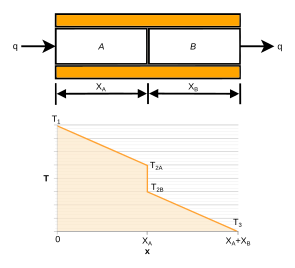
When two solid bodies come in contact, such as A and B in Figure 1, heat flows from the hotter body to the colder body. From experience, the temperature profile along the two bodies varies, approximately, as shown in the figure. A temperature drop is observed at the interface between the two surfaces in contact. This phenomenon is said to be a result of a thermal contact resistance existing between the contacting surfaces. Thermal contact resistance is defined as the ratio between this temperature drop and the average heat flow across the interface.
Example: In physics, thermal contact conductance is the study of heat conduction between solid bodies in thermal contact. The thermal contact conductance coefficient, {\displaystyle h_{c}}h_{c}, is a property indicating the thermal conductivity, or ability to conduct heat, between two bodies in contact. The inverse of this property is termed thermal contact resistance.
es: Conductancia de contacto térmico
Thermal contact resistance
conjunction
Contact resistance is highly dependent on surface roughness. The pressure that holds the two surfaces together also influences the contact resistance. It is observed that the thermal contact resistance decreases with decreasing surface roughness and increasing interface pressure. This is attributed to the fact that the contact surface between the bodies increases as the contact pressure increases. When two of those surfaces are pressed together, the peaks will make good contact with the material, but the valleys will form air-filled voids.
Example: Thermal contact resistance can be minimized by applying a heat conductive liquid called thermal grease, such as CPU grease, to the surfaces before pressing together. The main role of thermal grease is to eliminate gaps or air gaps (which act as a thermal insulator) from the interface area to maximize heat transfer.
es: Resistencia al contacto térmico
Total thermal resistance
noun
The thermal resistance of a material represents the ability of the material to oppose the flow of temperature. In the case of homogeneous materials, it is the ratio between the thickness and the thermal conductivity of the material; in inhomogeneous materials resistance is the inverse of thermal conductance.
Example: Thermal resistance is a heat property and a measurement of a temperature difference by which an object or material resists a heat flow.